
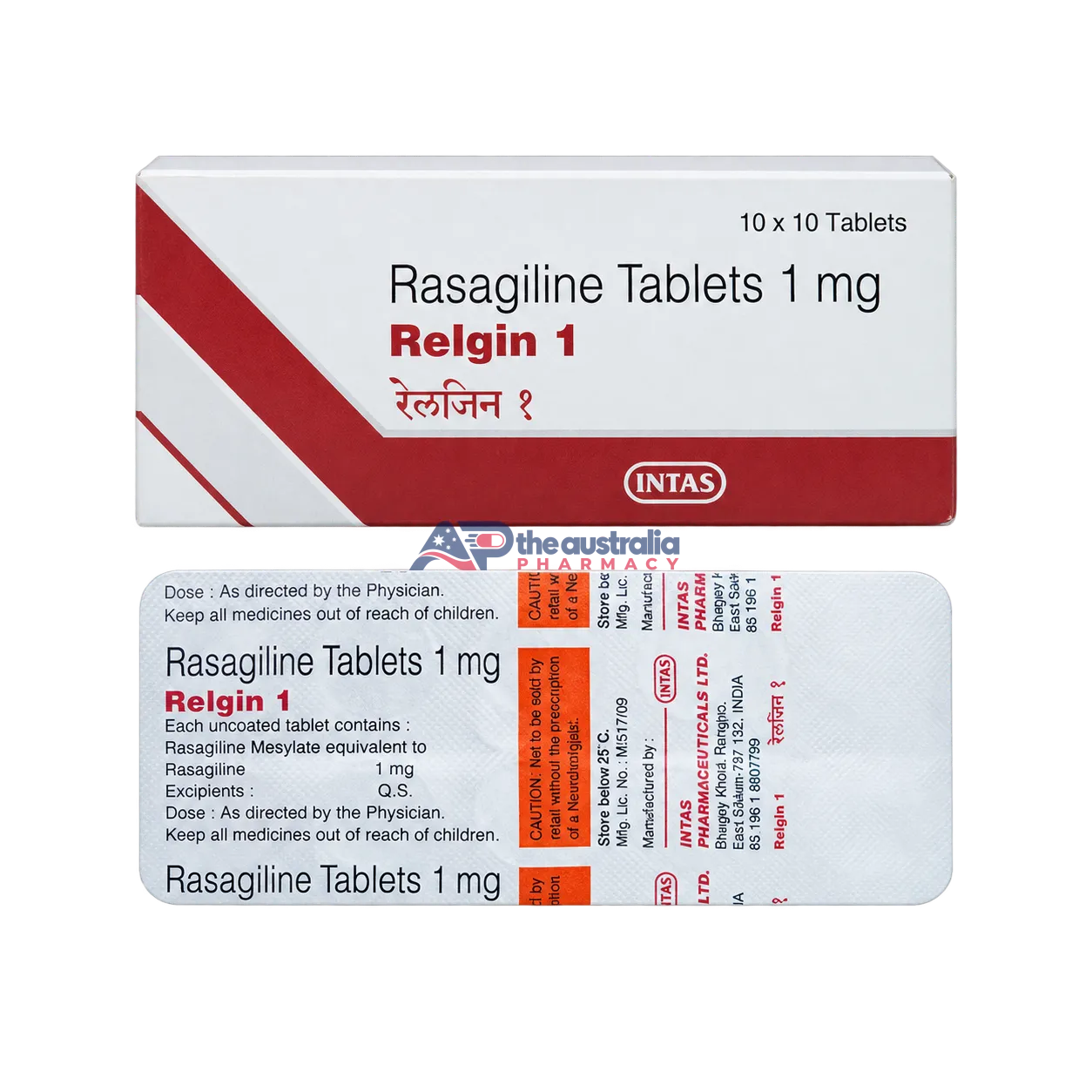
What is Relgin 1 mg?
Relgin 1 mg is a brand of rasagiline, a medicine used to manage symptoms of Parkinson’s disease. Each tablet contains 1 mg of rasagiline. It belongs to a group called MAO-B inhibitors, which help the brain use available dopamine more effectively.
Parkinson’s disease affects nerve cells involved in movement control. As dopamine levels fall, a person may develop slowness, muscle stiffness, and shaking. Rasagiline can help control movement symptoms, but it does not cure Parkinson’s disease or replace the need for ongoing neurological care.
Treatment should follow a confirmed diagnosis and a review of your other medicines. Not every tremor or movement difficulty is caused by Parkinson’s disease.
Product information
| Brand | Relgin |
| Active ingredient | Rasagiline |
| Strength | 1 mg per tablet |
| Dosage form | Tablet |
| Route | Oral |
| Brand company | Intas Pharmaceuticals Ltd. |
| Medicine class | Selective monoamine oxidase type B (MAO-B) inhibitor |
| Established ingredient use | Symptomatic treatment of idiopathic Parkinson’s disease |
| Treatment role | Alone, or with levodopa or a dopamine agonist when prescribed |
| Patient group | Adults; not recommended for people under 18 |
| Prescription requirement | Rasagiline is a prescription-only medicine in Australia |
What is Relgin used for?
Rasagiline can be prescribed on its own or added to treatment with levodopa or a dopamine agonist. Its role depends on your symptoms, response to existing medicines, and risk of adverse effects.
When levodopa begins to wear off before the next dose, movement symptoms may return during an “off” period. Adding rasagiline can help reduce these fluctuations in some people. Your specialist will assess whether this approach is suitable and whether another medicine needs adjustment.
Relgin is taken regularly as prescribed. Do not use it as an extra rescue tablet whenever stiffness or shaking increases.
How does rasagiline work?
Monoamine oxidase type B is an enzyme that breaks down dopamine in the brain. Rasagiline blocks this enzyme, allowing dopamine to remain available for longer.
This supports the chemical signalling involved in movement. It can also strengthen the effects of levodopa, which explains both its usefulness as an add-on treatment and the possibility of increased involuntary movements. Your treating clinician must make any changes to levodopa.
What are the benefits of Relgin 1 mg?
The expected benefits of rasagiline treatment include improved control of movement symptoms and, when added to levodopa, less time when its effect has worn off. The once-daily dosing schedule can also make the prescribed routine easier to organise.
The degree of improvement varies. It may take several weeks to assess the response, and taking more than prescribed does not reliably provide extra benefit. Review treatment alongside physiotherapy, exercise, and other support appropriate to your needs. Healthdirect’s Parkinson’s disease guide explains the wider approach to care.
Recommended dosage and administration
General dosing guidance
Australian rasagiline product information recommends 1 mg once daily, with or without food. Take your prescribed tablet with water at the same time each day, and follow the directions supplied with your medicine.
The 1 mg strength states the amount in one tablet; it does not establish whether that dose is suitable for you. Your prescriber must first review your liver function history and potential interactions. Do not exceed 1 mg a day or take extra tablets if symptoms worsen.
If rasagiline increases involuntary movements while you are taking levodopa, your clinician may adjust the overall treatment. Do not reduce levodopa or change another Parkinson’s medicine yourself.
Missed doses and overdose
Follow your dispensing label and supplied leaflet. Australian consumer guidance advises taking a missed dose if you remember it, unless the next dose is nearly due. If it is, skip the missed dose and resume the usual schedule. Never double a dose.
If you take too much, contact the Australian Poisons Information Centre on immediately, even if you feel well. Call 000 for collapse, seizures, severe breathing difficulty or unconsciousness.
Stopping treatment
Do not stop or change rasagiline without medical advice. Sudden changes to Parkinson’s treatment can cause serious problems. High fever, marked muscle stiffness or confusion following a treatment change needs urgent medical assessment.
Strengths and substitutes
Intas lists Relgin in 0.5 mg and 1 mg strengths. These are different tablet strengths, and the existence of a lower-strength product does not mean you should switch, split tablets, or alter your daily dose.
Azilect 1 mg and RASAGILINE-TEVA 1 mg are verified Australian rasagiline products. They contain the same active medicine at the stated strength, but a pharmacist must confirm any substitution, including the formulation, prescription, and supplied product information.
Levodopa, dopamine agonists, and other Parkinson’s treatments have different roles and dosing. They are not direct milligram-for-milligram replacements. Do not add another MAO inhibitor, such as selegiline, to rasagiline.
Relgin side effects
- Headache.
- Nausea or indigestion.
- Joint or neck discomfort.
- Dizziness or light-headedness, particularly when standing up.
- Increased involuntary movements, especially with levodopa.
Sleepiness, hallucinations and behaviour changes
Rasagiline can cause daytime sleepiness or sudden sleep episodes. Do not drive, operate machinery or work at heights if you become sleepy or fall asleep without warning. Tell your prescriber about any previous sleep attacks before starting; Australian guidance also advises against these activities during treatment if you have previously fallen asleep without warning. Discuss alcohol because it may add to dizziness, poor coordination or sedation.
Report hallucinations, confusion or new compulsive urges, including gambling, spending or sexual behaviour. A carer may notice these changes before the person taking the medicine does. Your clinician should assess them and decide whether treatment needs to change.
Symptoms needing emergency care
Seek emergency help for high fever with agitation or confusion, heavy sweating, a fast heartbeat and muscle stiffness or twitching. This combination can indicate serotonin syndrome, a potentially life-threatening interaction.
Call for severe chest pain, sudden weakness or difficulty speaking, seizures, collapse, or swelling of the face or throat with breathing difficulty. A sudden severe headache with visual changes can also signal dangerously high blood pressure and needs urgent assessment.
Safety advice and important interactions
Who should avoid rasagiline?
Do not take it if you are allergic to rasagiline or an ingredient in the supplied tablet. Under Australian product information, do not use rasagiline in people with hepatic insufficiency (impaired liver function). Tell your prescriber about any liver problem before treatment, and discuss kidney disease, blood-pressure problems and a history of hallucinations or psychosis.
It is not recommended for children or adolescents under 18 because safety and effectiveness have not been established for that group.
Medicines that must be checked
Have a pharmacist review every prescription medicine, nonprescription product, and supplement before starting rasagiline or adding another treatment. Important combinations to avoid include:
- Other MAO inhibitors, including selegiline, and products with MAOI activity such as St John’s wort.
- Pethidine, tramadol, tapentadol, methadone and dextropropoxyphene.
- Dextromethorphan, found in some cough medicines.
- Ciprofloxacin and other potent CYP1A2 inhibitors, under Australian rasagiline guidance.
Avoid fluoxetine and fluvoxamine as well. Other antidepressants require careful specialist assessment because of serotonin-syndrome risk. Check before taking cold or flu remedies containing decongestants, including pseudoephedrine. Tell doctors and dentists that you take rasagiline before procedures or new pain treatment.
Some medicine changes require a gap of at least 14 days after stopping rasagiline and starting rasagiline after fluoxetine requires at least 5 weeks, according to the product information. Your prescriber must plan these intervals; do not stop an antidepressant or Parkinson’s medicine yourself.
Food and tyramine
Pregnancy and breastfeeding
Tell your clinician if you are pregnant, planning a pregnancy or breastfeeding. Human pregnancy data are inadequate, and rasagiline should be used during pregnancy only when clearly needed after medical assessment.
It is not known whether rasagiline passes into human breast milk. It may also interfere with milk production. Breastfeeding requires an individual discussion of the treatment’s benefits, uncertainties and alternatives.
Monitoring during treatment
Keep follow-up appointments, so your team can review movement symptoms, “off” periods, blood pressure, sleepiness, falls and behaviour changes. A brief symptom diary can help explain what happens between appointments.
Periodic skin examinations are recommended for people with Parkinson’s disease, including those taking rasagiline. Report a new or changing mole or other suspicious skin lesion. The relationship between Parkinson’s disease, its treatments and melanoma is not fully understood; a skin change should be assessed rather than attributed automatically to the medicine.
How to store Relgin tablets
Keep tablets in their original packaging, away from excess heat, moisture and children’s reach. Follow the temperature limit printed on your own pack. Do not use expired or damaged medicine. Ask a pharmacist about disposal and arrange repeat prescriptions early enough to avoid an unintended treatment interruption.
Reviews
There are no reviews yet.